
Blackjack Guide: How to Play, What to Bet, and When to Make Your Move

You glide to the blackjack table with a pep in your step, and the dealer deals your first two cards. The record screeches to a halt. You know you’re supposed to do something…but what? By the end of this blackjack guide, you’ll know your options and how to confidently declare your move.
Blackjack is an easy game: you must beat the dealer without surpassing 21. From there, you only need to understand blackjack rules, five key decisions, and a handful of common hands at the heart of blackjack basic strategy.
- How blackjack works
- Blackjack card values
- Playing a hand from start to finish
- 5 choices at the table
- Reading the dealer’s card
- The hands players get wrong
- Beginner habits
- Where to play your first hand online
- FAQs
How Blackjack Works
When you play blackjack, you’re competing only against the dealer. There might be five other players at the table, but the showdown is always between your hand and the dealer’s.
You’ll place a bet, the dealer will hand each player two face-up cards, and the dealer will take one face-up and one face-down. Each player makes their move, and the dealer settles the bets.
The most important card at the table, aside from your own, is the dealer’s face-up card, called the “upcard.” This card determines almost every decision you make because it gives you a clue about how strong or weak their hand might be.
While you are free to make judgment calls on your next move, the dealer is not. They must continue taking cards until they reach 17.
What the Cards Are Worth
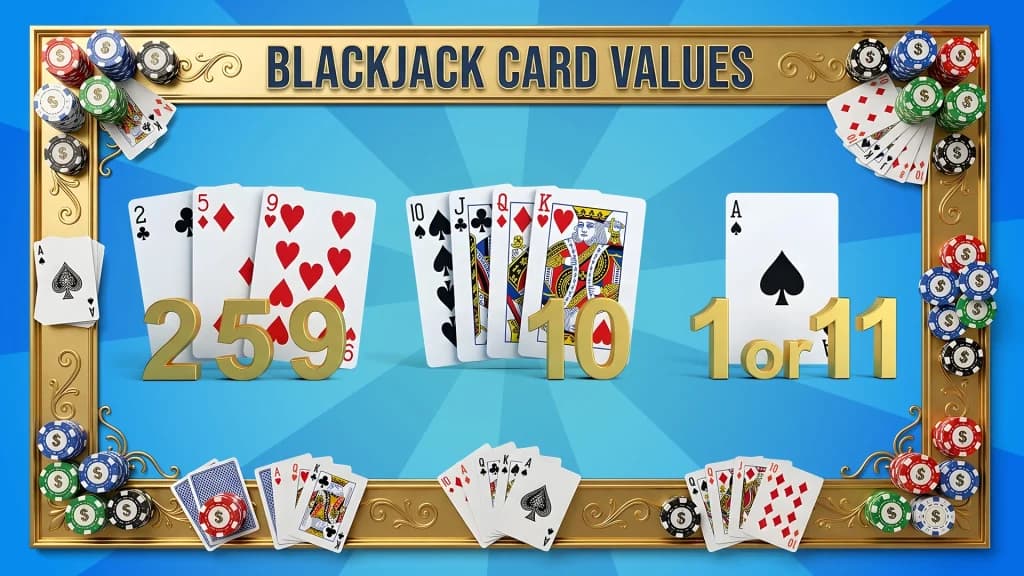
Blackjack card values are divided into three groups: number cards, face cards, and the ace.
- Numbered cards from 2–9 are worth their stated value. A 9 is worth 9, a 5 is worth 5, and so forth.
- Face cards and the 10-value card (10, Jack, Queen, King) are all worth 10.
- Aces are worth either 1 or 11, depending on what helps your hand the most.
All blackjack hands fall into two categories: hard and soft.
If your hand does not contain an ace, it’s called a hard hand. For example, a 4+8 is a hard 12.
If your hand contains an ace, that’s called a soft hand because the ace makes your total flexible. A 7+A could be either 8 or 18.
If you’re the lucky duck who receives a 10-value card and an ace on your first deal, such as K-A, you have a natural blackjack, or a “natural.” In that case, you receive a 3:2 payout right off the bat, instead of 1:1 for an ordinary win.
A “push” is a tie. You and the dealer finish with the same total, and your original bet is returned.
To “bust” means your hand has surpassed 21 and you automatically lose.
Playing a Hand From Start to Finish
The steps below walk you through one complete blackjack round from the first chip down to the final payout.
- Place your bet. Choose your stake and put it down before the cards are dealt.
- Receive your first two cards. The dealer also gets two, with one face up and one face down. That hidden card is the hole card.
- Take your turn. Based on your total and the dealer’s up card, you decide whether to hit, stand, double down, split, or surrender if the table allows it.
- The dealer reveals the hole card. Once your turn ends, the dealer shows their second card and plays according to the table rules. They keep drawing on 16 or lower and stop on 17 or higher, though soft 17 rules can vary.
- The hand is settled. If your total beats the dealer without going over 21, you win. A standard win pays 1:1. A natural blackjack pays 3:2, though some tables pay 6:5. If you and the dealer finish on the same total, it’s a push, and your original bet is returned.
If the dealer finishes with a higher valid total, or you bust first, you lose your bet.
Your Five Choices at the Table
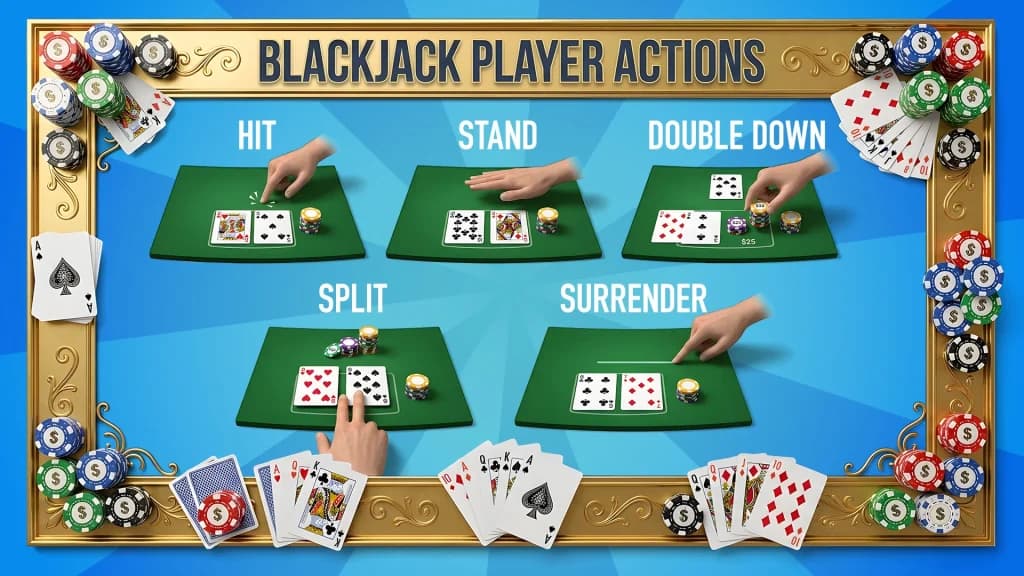
While you might see this and that rule or piece of advice for playing blackjack, there are only five actual moves you can make: hit, stand, double, split, or surrender.
To hit means to receive another card.
Standing is the opposite, and you keep your total as-is, without receiving any additional cards.
Doubling down means you pay up another bet equal to your original and receive exactly one more card, after which your turn ends.
If you receive a pair, you can opt to split. That means you separate the two cards into two separate hands, and place a bet equal to your original wager on the additional hand. Then, you play them each out separately.
You can only surrender in blackjack if the table allows it. Some don’t. When you surrender, you forfeit your hand before playing it out, and the dealer returns half of your bet.
| What it means | When it is usually the right call | What to watch for | |
| Hit | Take another card | Low totals that need improvement | Another card can push you over 21 |
| Stand | Keep your current hand and end your turn | Strong totals, or some 12-16 hands against a weak dealer card | The dealer’s up card can make standing on a modest total the better play |
| Double down | Double your original bet and take exactly one more card | Strong two-card totals such as 10 or 11 | You only get one additional card |
| Split | Turn a pair into two separate hands and place an equal second bet | Aces and 8s, plus other pairs depending on the dealer’s card | Each hand plays separately; split and re-split rules vary |
| Surrender | Give up the hand and lose half your original bet | Hard 15s or 16s against a strong dealer card | Not every table offers it; surrender rules can vary |
Reading the Dealer’s Card: The Logic Behind Every Decision
Every decision you make in blackjack comes down to one key factor: how strong the dealer’s up card is.
- Weak dealer upcards include 2–6.
- Strong ones are 7–Ace.
Blackjack rules say the dealer must keep hitting until they reach hard 17, and sometimes soft 17, too, depending on the H17 vs. S17 rule.
When they have a weak upcard, they’re forced to keep drawing, which increases their chances of going over 21. If they have a strong card, they’re more likely to pull one solid 10-value card that lands them at 17 or higher, at which point they’re in a strong position and no longer have to hit.
Your optimal move, then, depends on how likely the dealer is to surpass 21 (bust).
When to hit in blackjack: Hit on any total of 11 or lower. You can always improve these. With a hard 12 or higher against a strong dealer upcard, it’s better to hit and improve your total so you can fight back.
When to stand in blackjack: When you have a total of hard 12 or higher and the dealer shows a weak upcard, you can generally stand and let them (hopefully) bust themselves to oblivion.
This logic forms the basis of blackjack basic strategy. It isn’t just how to play blackjack for beginners; seasoned players follow the same exact guidelines. Still, the exact move depends on the situation and exact cards in play. That’s why you have a chart.
Use a Strategy Chart
Strategy charts come from calculating the expected outcome of each possible decision against each dealer upcard. These calculations aren’t your job; someone’s already done them for you.
That said, no matter how Sheldon-Coopery a mathematician was, blackjack strategy charts can only lower the house edge so much. They do not have the power to predict the next card or guarantee a result. They show the statistically best move that will save you money over time.
The good news is that you don’t need to memorize one. You can save that brain juice for the lyrics to Bohemian Rhapsody. Now that’s two skills to impress at parties. You can keep a chart open and use it as a reference. Slowly but surely, the patterns will stick, and eventually you won’t need a chart at all.
Our guide on How to Memorize Blackjack Basic Strategy can help once you want to commit more of it to memory.
The Hands New Players Get Wrong Most Often
Many hands in blackjack are obvious. If you have 4 and the dealer has 8, of course you’re going to hit. But other hands aren’t so cut and dry and cause more second-guessing than drafting a work email (three exclamation points? Wow.)
Learn these, and you’ll already be a few steps ahead of most blackjack beginners:
- Hard 16 vs. dealer 10: Surrender/hit. Surrender if the table allows it; otherwise, hit. A dealer 10 is strong, and standing on 16 leaves you with one of the worst starting situations in blackjack. It’s unpleasant either way because, mathematically, it’s the equivalent of wet socks.
- 12 vs. dealer 5: Stand. The dealer’s 5 is weak and forces them to keep drawing, which increases their chances of busting. Taking another card yourself increases your own chance of busting, so why put yourself in the same risky situation as the dealer?
- 11 vs. dealer 10: Double. Double down under standard basic strategy. With an eleven, you need just one 10-value card to hit 21, and they are the most abundant in the deck.
- Pair of 8s: Split. One of the biggest questions in blackjack: Do you split 8s? Yes. Split them. A hard 16 is a groan fest, so turning your two 8s into separate hands gives each one a fresh opportunity.
There’s a line in blackjack you never cross: hitting on a hard 17 or higher. Any card of 5 or higher will bust you. The guidelines are different for a soft 17, because soft hands have added flexibility. That’s why questions such as “Do you hit soft 18 in blackjack?” have their own special answer.
Hard 15, also known as the Headache Hand (our term, not official), is a tough choice against a dealer’s 7–A. You’ll mostly hit, but surrender in some key situations depending on the table rules. It’s such a rough hand that it got its own guide: How To Play a Hand of 15 in Blackjack.
Beginner Habits, Bets to Skip, and Setting a Budget
The most costly rookie blackjack mistakes come from trying to rescue a bad situation. Don’t cut your bangs again if you’ve already taken out a chunk, ya know?
To avoid looking like Spok and getting into tough situations in blackjack, keep these habits in your back pocket:
- Skip insurance. The name makes it sound protective, but insurance is really a separate side bet that the dealer has blackjack. It pays 2:1, but the odds don’t justify taking it. Our guide, “What is Blackjack Insurance?”, explains the reasoning in more detail.
- Don’t chase losses. Hitting a losing streak does not mean you’re guaranteed to start winning. If you hit a stop-loss limit, quit the game.
- Don’t raise your stake after a bad run. This is, again, related to chasing losses. Don’t start raising your bet, hoping to recover. Instead, maintain a consistent stake size while following basic strategy.
- Set your session budget first. Pick an amount you’d be completely comfortable losing, then treat it as a hard ceiling. That simple rule is the foundation of good blackjack bankroll management.
The golden rule is to only play blackjack with money you’re comfortable losing, and stop when you reach the limit you set beforehand. If gambling starts to feel like more stress than fun, the National Problem Gambling Helpline is available at 1-800-522-4700 and ncpgambling.org.
Where to Play Your First Hand Online
Online blackjack is a comfortable place to start. When you play blackjack games online, you set the pace, and there’s nobody pressuring you to make your move.
The mechanics of online blackjack are familiar, but the experience is a bit different than playing on a casino floor. Buttons replace physical hand signals, and it’s easier to keep a basic strategy chart at arm’s length while you learn, next to the iced tea.
You also have more blackjack variations to choose from:
- Classic blackjack: The rules are familiar, and it’s a straightforward starting point.
- Single-deck blackjack: Uses one deck rather than two, four, or even eight, and has the lowest house edge. It’s rarely available in land casinos.
- Double-deck blackjack: Played with two decks, and again, has a lower house edge and is rare in land casinos.
- Live dealer blackjack: A mix of land and online blackjack. When you play live blackjack online, a real human dealer runs the game in a one-way video stream, using professional studio equipment. You get the social, real-time flow of blackjack without leaving home.
Start small for your first few sessions and pick a stake that suits your budget. Play for free in Practice Play to get comfortable with the chart and key moves.
That’s how to practice blackjack. You don’t practice by cranking up your bets because the Holy Chart is by your side. While we do love it—revere it, even—remember, the chart is not a guaranteed way to win. It’s simply the mathematically best choices over time.
Pull Up a Chair
You now know that the goal of playing blackjack is to beat the dealer without surpassing 21. You know the five key decisions you can make, and how to use the dealer’s upcard to guide your decision.
You are now, for all intents and purposes, ready.
Read up on more strategy tips, or try playing blackjack for yourself. The stage is yours.
FAQs
Should I hit or stand on 16 against a dealer’s 10?
If you can surrender, do it. If not, hit. You’re in a tough spot no matter how you look at it, since this is a strong dealer total. But at least hitting gives you a fighting chance.
Should I hit a 12 against a dealer’s 5?
No, you should stand. A 12 isn’t great, but a five really really isn’t great for the dealer. They have to keep drawing and have a relatively high risk of busting. It’s best to stay put and not take the same risk when the dealer is in the hot seat.
What is the unluckiest hand in blackjack?
A hard 16 against a dealer’s 10 puts you in a tough spot. Your total is too weak to stand confidently, yet high enough that many cards will bust you if you hit. Take surrender if it’s available; otherwise hit.
Do I need to memorize a strategy chart before I play?
Nope! You can keep a strategy chart handy while you play and refer to it as many times as you need. Find your hand total in the left column and the dealer’s upcard along the top. The joining cell will tell you the optimal move.
Should I ever take the insurance bet?
No. Beginners should skip the insurance bet. It’s a separate side bet with a much higher house edge.
Why does it matter whether the dealer hits a soft 17?
When the dealer can hit on soft 17, they have more opportunities to improve. This changes the recommended move on a few totals. Look for H17 or S17 in the table rules before you play: H17 means the dealer hits soft 17, while S17 means they stand.
Can I practice blackjack without betting real money?
Yes. When you play blackjack online, you can select “Practice Play,” and you’ll get a pretend balance to practice with. The game works exactly the same as it would if you paid normally, so you can brush up on your strategy and get comfortable before committing real money.
More Blackjack Tips & Tricks

November 3, 2026
Blackjack Guide: How to Play, What to Bet, and When to Make Your Move
Learn how to play blackjack, including the card values, the five key moves you can make, and a handful of special hands. It’s easy once you get the hang of it.

September 21, 2026
Blackjack Terms: A Guide to the Language of the Table
This blackjack glossary covers all of the terms you’ll hear when playing blackjack, from moves to rules to slang. Learn the terms now, grouped by situation.

September 3, 2026
How Colin Jones and the Church Team Conquered Blackjack
Born-again Christians, cowboy disguises, and a million-dollar bankroll. The story of the Church Team is unlike anything else in blackjack history.

August 28, 2026
Baccarat vs Blackjack House Edge: Which Game Actually Gives You Better Odds?
A badly played blackjack hand can have worse odds than a well played game of baccarat. See how the odds change depending on your play.