
What Is DAS in Blackjack? Double After Split, Explained

What is DAS in blackjack? DAS stands for “Double After Split.”
You’ll encounter this rule on an online blackjack paytable or rules placard if you’re playing in person. You’ll also see it factored into strategy charts, which is a key focus of this DAS guide.
We’ll also dive into the soup and salad of it all, otherwise known as the details. Specifically, how this rule plays out in a hand, which pairs change their optimal move because of DAS, and how it improves the overall blackjack house edge.
- What DAS means in Blackjack
- How double after split works
- DAS vs NDAS
- The pairs where DAS changes the play
- What DAS is worth at the table
- 6:5 Payout cancels out DAS
- Check whether a table allows DAS
- Other Blackjack abbreviations
- Should you look for DAS tables?
- FAQs
What DAS Means in Blackjack
DAS is a blackjack rule that stands for “Double After Split.”
When you split a pair and DAS is allowed, it means you can double on one of those new hands. You pay an amount equal to your original bet and receive exactly one more card.
To be clear, DAS is a rule that applies after the split has already occurred. It doesn’t affect whether you can split in the first place; that’s another guide entirely, which we happen to also have: When to Split in Online Blackjack.
Now that we know what DAS means in blackjack, what happens when you can’t split? That’s called NDAS, or No Double After Split. You might also want to call it a nuisance, for reasons we’ll promptly get into.
How Double After Split Works, Hand by Hand
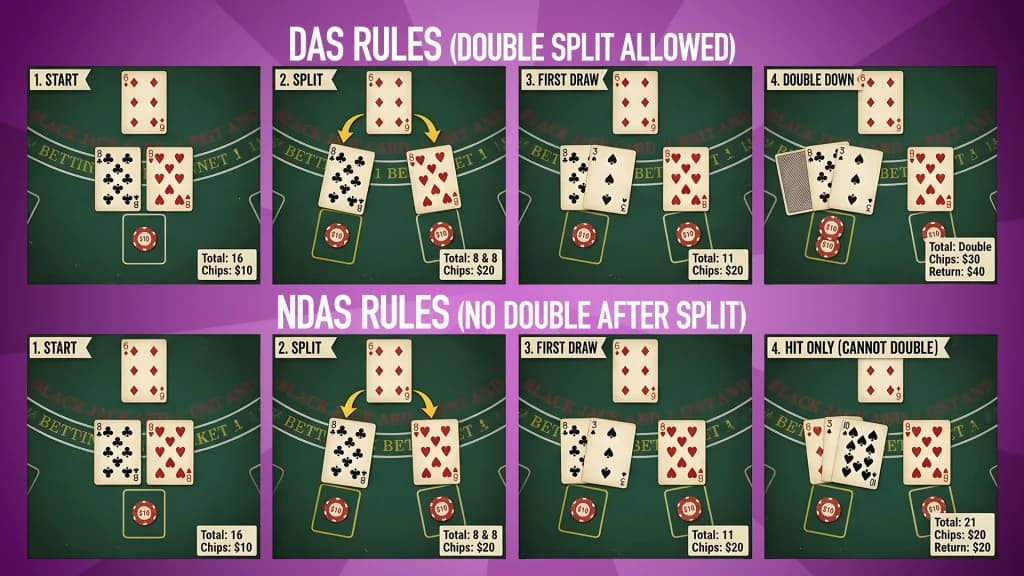
Let’s go over some examples. One of the primary questions on all blackjack players’ minds is: Do you split 8s in blackjack? And also: Do comps include poolside margaritas? The answer is always, and we sincerely hope so.
Suppose you have two 8s and you split. So far so good. Here’s how it could play out with DAS rules:
- You bet $10 and receive two 8s against a dealer 6.
- You split them, adding $10 to pay for your extra hand.
- You draw a three on one of the hands and make 11.
- Now we’re talkin’! That’s one of the strongest hands in blackjack. Now you double that hand, adding $10 and taking one final card.
If you win, you’ve successfully transformed a terrible total (16) into a winning double with a $40 return. Now let’s compare the same hand to NDAS rules.
- You bet $10 and receive two 8s against a dealer 6.
- You split them, adding $10 to pay for your extra hand.
- You draw a three on one of the hands and make 11.
- But now, you can’t double, so you hit, regular style. If you win, you only receive $20 instead of $40.
See the difference? Being allowed to double after splitting opens the door to more money for certain stronger hands.
DAS vs NDAS: What Actually Changes
DAS is a rule that determines whether or not you can double down after a split. It is not an outcome of a hand—just so we’re clear, yet again. Can you tell that this comes up a lot?
DAS/NDAS rules aren’t uniform across tables, online or in person, so always double-check before you play.
| DAS table | NDAS table | |
| Options after a split | Hit, stand, or double; resplit if allowed. | Hit or stand; resplit if allowed. |
| Split 8s, draw a 3 for 11 | Double with an equal bet and take one final card. | Hit without changing your stake. |
| Money in play on that round | A $10 opening bet becomes $30 after splitting and doubling one hand, or $40 if you double both. | A $10 opening bet becomes $20 after splitting into two hands. |
| Effect on pair-splitting strategy | Makes splitting correct in more situations because you can double favorable draws. | Makes hitting the better move for some pairs you’d normally split with DAS. |
| Effect on the house edge | Lowers the house edge by roughly 0.14% compared with an otherwise identical NDAS table. | Raises the house edge by roughly 0.14% compared with an otherwise identical DAS table. |
The Pairs Where DAS Changes the Right Move
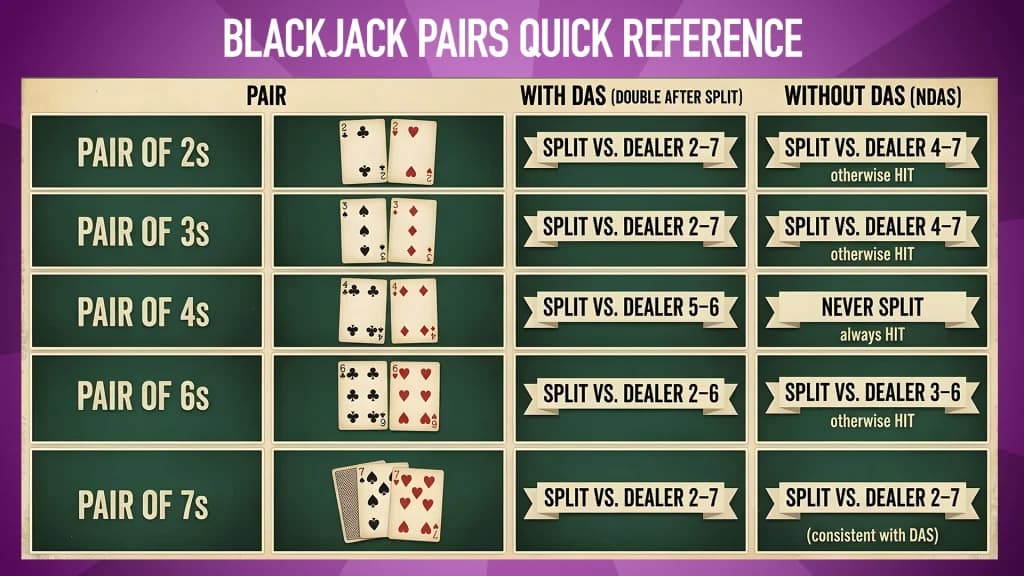
A basic blackjack strategy chart factors whether you can double down on a split into its correct move. In some cases, it’ll tell you to split as long as DAS is allowed, but to hit if the table is NDAS. The most common pairs that fall under this category are: 2s, 3s, 4s, 6s, and 7s.
The explanations below assume 8 decks. Your strategy will be different in a single-deck game.
Pairs of 2s and 3s
The dealer’s upcard is the key distinction when considering whether to split 2s in blackjack, and the same goes for 3s.
When you have a pair of 2s or 3s and the dealer’s upcard shows a 2 or 3, split if DAS is allowed. If not, hit. If the dealer shows a 2 through 7, split in both DAS and NDAS.
Pairs of 4s
Another big question is whether you should split 4s in blackjack. When you have a pair of 4s on a DAS table, split only when the dealer shows 5 or 6; otherwise, hit.
Pairs of 6s and 7s
Finally, do you split 6s in blackjack? How about 7s?
With a pair of 6s under DAS rules, split if the dealer shows a 2; otherwise, hit. Regardless of the rule, always hit when the dealer shows 3 through 6.
For a pair of 7s, always split when you see a dealer’s upcard of 2 through 7, and that applies to both DAS and NDAS.
In the case of 8s and Aces, always split in both DAS and NDAS in blackjack.
What DAS Is Worth at the Table
DAS gives a pleasant boost to your player return, but don’t expect a butler in your third estate or anything. It’s a modest bump, lowering the house edge by roughly 0.14% compared with an otherwise identical NDAS table.
If you bet $1,000, you’d lose about $1.40 when you follow correct basic strategy. Even then, your actual session can fall above or below that average, and the house still maintains its edge either way.
Splitting and doubling both hands puts four times your opening stake in play, so set your budget before playing. The National Council on Problem Gambling offers resources and support for responsible gaming.
Why a 6:5 Payout Cancels Out DAS
While it’s true that DAS sweetens the deal, a 6-to-5 blackjack table will leave you worse off overall. It’s like a bakery adding sprinkles to a stale cupcake.
A 6:5 payout for blackjack far outweighs the benefits of the DAS rule, as it adds about 1.39% to the house edge. That’s about 10x the benefit that DAS provides.
When choosing a table, the blackjack payout takes priority over the other rules, including DAS.
Split Aces: The Usual Exception
Aces are the exception to DAS in blackjack, because you know there’s gotta be an exception; “I before E, except after C” and all that jazz.
Even when DAS is allowed, most tables will deal split Aces just one card and call it a day. You can’t hit again or double down, even if the table allows DAS on other split hands.
Check the rules before you play to see how Aces are handled.
How to Check Whether a Table Allows DAS
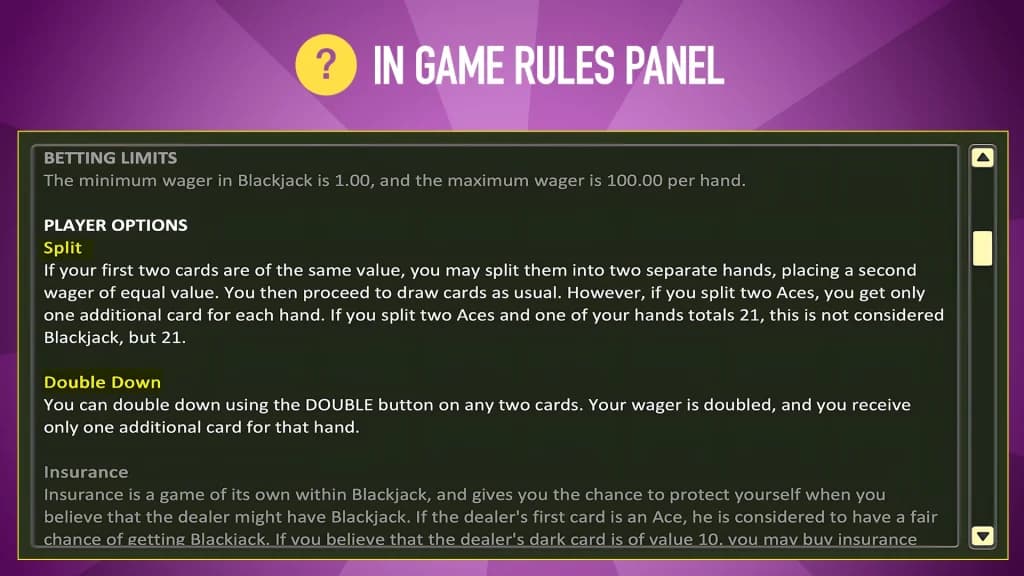
When you play blackjack games online, you’ll find DAS rules in one of the places below:
- The rules or info panel. Look for “DAS,” “double after split,” or “doubling after splitting allowed.”
- The paytable. You might find doubling and splitting restrictions posted alongside the payouts.
- Read the live dealer rules screen. Open the table’s information menu to check its specific rules.
If you can’t find the rule, treat DAS as unavailable until you can confirm it with the dealer or game provider.
Other Blackjack Abbreviations Worth Knowing
DAS isn’t the only abbreviation on a rules panel. OMG, FWIW, there are more.
From resplitting Aces to H17 vs. S17 in blackjack, the table below explains what each term means and how it affects your game.
| What it stands for | What it changes for the player | |
| DAS | Double after split | You can double down on a fresh hand after splitting a pair. |
| NDAS | No double after split | You can split pairs, but you can’t double down on the new hands. |
| RSA | Resplit Aces | If you split and draw another Ace, you can split on that Ace, too. |
| H17 | Hit soft 17 | The dealer must hit on a total of 17 that contains an Ace. |
| S17 | Stand on soft 17 | The dealer must stand on a total of 17 that contains an Ace. |
| DA2 | Double on any two cards | You can double on any two cards you’re dealt. (Some rules limit the totals you can double on) |
| 6:5 | Natural blackjack pays six-to-five | A $10 blackjack earns $12 profit, compared with $15 at a 3:2 table. |
Should You Look for DAS Tables?
Yes, it’s the better choice if we’re comparing just DAS vs NDAS, but only as long as the other rules match, too.
The order of importance is as follows:
- 3:2 blackjack payout (not 6:5)
- Fewer decks are better
- S17 (instead of H17)
- Surrender allowed
- DAS
Don’t let a DAS rule override a 6:5 table. Capiche?
Grab the strategy chart that aligns with your game’s rules, and play classic blackjack online.
If you need a hand memorizing your strategy chart to avoid the back-and-forth eye cha-cha between the game and the chart, use our guide on how to memorize blackjack basic strategy.
FAQs
What does DAS stand for in blackjack?
DAS stands for Double After Split. This means that after you split a pair, you can double down again, paying an additional equal bet and receiving one more card.
What does NDAS mean?
NDAS stands for No Double After Split. It means that after you split a pair, you cannot double down again.
Can you double down after splitting Aces?
No, not in most tables. Most of the time, you’ll be able to receive one additional card after splitting Aces. Double-check the rules to verify what’s allowed at your table.
How much does DAS change the house edge?
With DAS rules in effect, the house edge would fall roughly 0.14%. However, don’t confuse this adjustment with a higher chance of winning when you double after splitting. It increases the margin over time.
Does DAS mean I should split more often?
Yes, but only in specific situations. At standard four-to-eight-deck tables with the DAS rule, you’d change certain decisions involving pairs of 2s, 3s, 4s, and 6s. Pairs of 7s can also change in games with fewer decks. Follow a strategy chart that matches the deck count and table rules.
How do I know if an online blackjack table allows DAS?
In land-based blackjack, the posted rules will tell you if DAS is available. For online blackjack, look for the rules panel or paytable, and the info screen for live dealer blackjack. If you don’t see it listed anywhere, assume it’s unavailable.
Is a table with DAS always the better choice?
No. DAS improves an otherwise identical table, but other rules can outweigh it. For instance, a 6:5 blackjack payout adds roughly 1.39% to the house edge compared with 3:2, and this disadvantage would far exceed the advantages of DAS.
More Blackjack Strategies

November 3, 2026
Blackjack Guide: How to Play, What to Bet, and When to Make Your Move
Learn how to play blackjack, including the card values, the five key moves you can make, and a handful of special hands. It’s easy once you get the hang of it.

September 21, 2026
Blackjack Terms: A Guide to the Language of the Table
This blackjack glossary covers all of the terms you’ll hear when playing blackjack, from moves to rules to slang. Learn the terms now, grouped by situation.

September 3, 2026
How To Deal Blackjack: Run the Table at Your Next Game Night
The crew is swinging by for blackjack night, and you’re the dealer. But wait…how do you deal the cards? Learn the rules and moves for dealing blackjack.

September 3, 2026
How Colin Jones and the Church Team Conquered Blackjack
Born-again Christians, cowboy disguises, and a million-dollar bankroll. The story of the Church Team is unlike anything else in blackjack history.