
What Is an Ace in Blackjack? The Card That Plays Both Ways
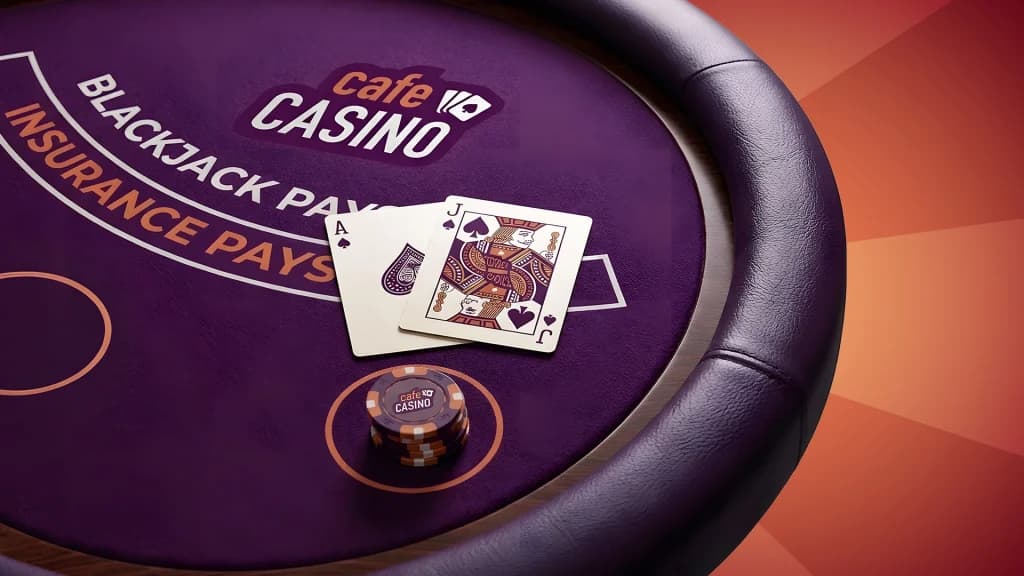
An ace appears as your first card, and the satisfaction is akin to finding the cold side of the pillow. The ace counts as either 1 or 11, depending on which total helps your hand more. This added flexibility is a blackjack boon, and we could cozy up to it all day. But now what? (Coffee?)
This guide answers what an ace is in blackjack, including how its value works, soft vs. hard hands, the most common ace combinations, and what happens when the dealer is the one with the ace.
- What is an ace worth?
- Soft hands vs hard hands
- Common ace hands
- How to play your ace hands
- What happens when the dealer has an ace?
- Putting your ace to work
- FAQs
What Is an Ace Worth in Blackjack? 1 or 11
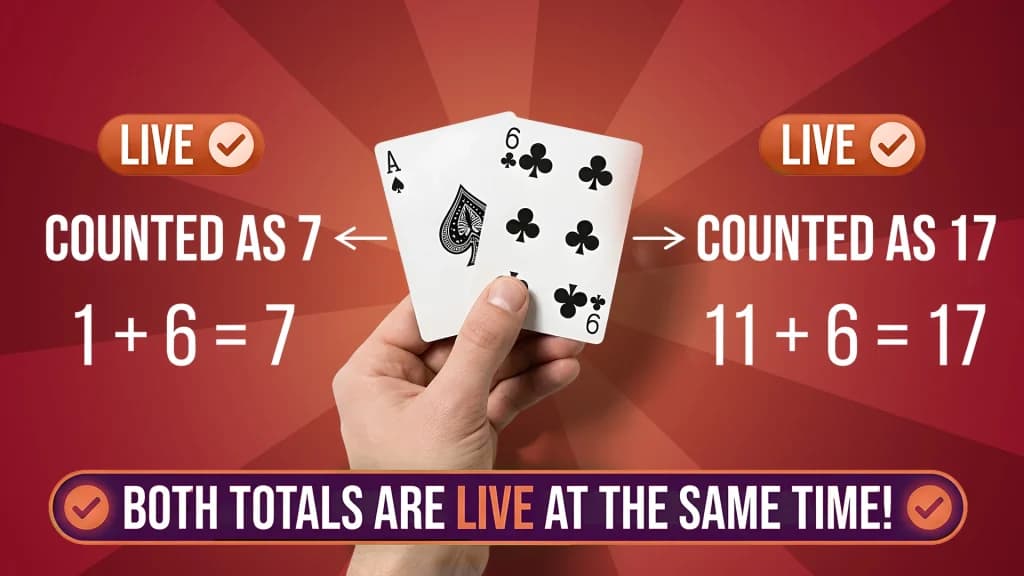
Most blackjack card values are what they are. A 6 is a 6. A 2 is a 2, and a Queen is worth 10, especially when she’s feelin’ her new tiara.
An ace is different. This card flexes between 1 and 11. And indeed, “flex” is appropriate, since it has the power move of changing based on which total helps your hand more.
You don’t have to worry about choosing a value; no mental math required. Your ace automatically counts as 11 unless that would push your total over 21, in which case it counts as 1. As more cards arrive, the value of your ace can change in order to keep you at 21 or under. It won’t get you past the bouncer at your local dive, but it’s a great help in blackjack.
If you’re playing online, the game will show you both totals. If you have an A + 6, your hand appears as 7/17.
Although it feels like a face card, an ace is never worth 10, and its suit makes no difference to its value.
Soft Hands vs. Hard Hands: How the Ace Changes Your Total
The game of blackjack has soft hands and hard hands.
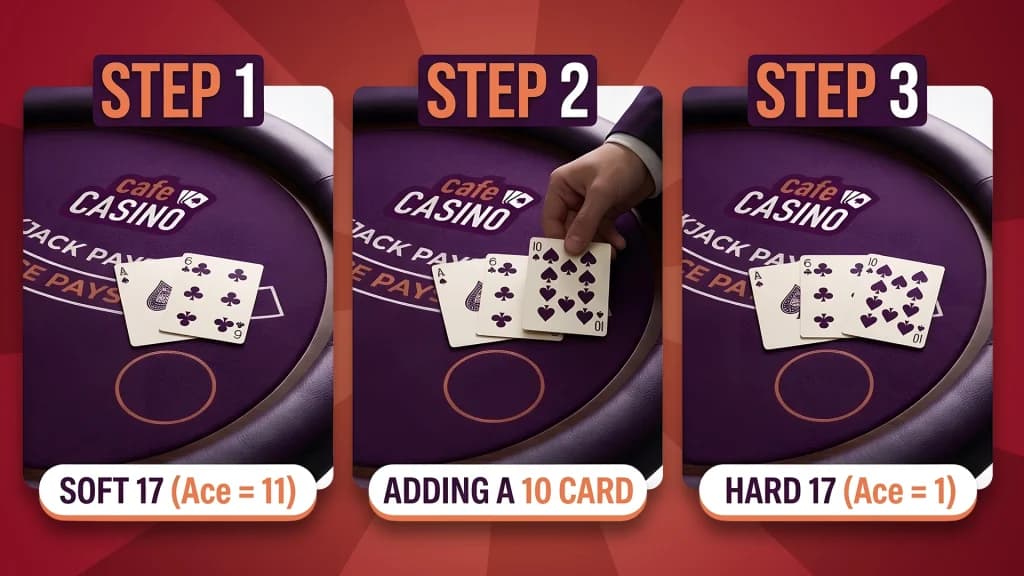
A soft hand is one that contains an ace that can still count as 11 without busting. For instance, Ace + 6 makes soft 17, and you’ll often see it shortened to A/6.
The correct move for soft 17 is either to hit or double, which surprises some players. Get the complete details on this hand in our guide: What is a soft 17 in blackjack?
A hard hand either means there is no ace involved or the ace must be counted as 1. An example would be Ace + 6 + 10, which is hard 17.
What Makes a Hand Soft
A soft hand is called soft because drawing another card cannot make you bust. The name doesn’t do it justice, as it makes it sound weak, when it’s quite the opposite. It’s giving…Hagrid.
The ace acts as a safety net that protects you from busting, so you open up your options and can play more aggressively with some soft totals than you would with their hard counterparts.
Still, a soft hand doesn’t mean you should automatically hit. That depends entirely on which soft hand you have and the dealer’s upcard.
When a Soft Hand Turns Hard
Let’s say you get an Ace + 4 (A/4). That starts as soft 15, with the ace counting as 11. You hit and draw an 8. Keeping the ace at 11 would give you 23, so it automatically changes to 1. Now you have hard 13.
From there, play the new hard hand as you normally would against the dealer’s upcard.
Common Ace Hands and What They Add Up To
| Hand | Possible Totals | Hand Name | Typical Play |
| Ace + 10, J, Q, or K | 11 or 21 | Blackjack, as long as it’s within your first two cards. | Do nothing; it’s an automatic win or push |
| Ace + 9 | 10 or 20 | Soft 20 | Stand |
| Ace + 8 | 9 or 19 | Soft 19 | Mostly stand, double against 6 in H17 |
| Ace + 7 | 8 or 18 | Soft 18 | Stand vs. 2, 7, or 8; double vs. 3–6; hit vs. 9–Ace |
| Ace + 2 to Ace + 6 | 3–7 or 13–17 | Soft 13–17 | Hit or double, depending on the dealer’s upcard |
| Ace + Ace | 2 or 12 | Pair of Aces / soft 12 | Split |
Ace and a Queen, King, Jack, or 10: Blackjack
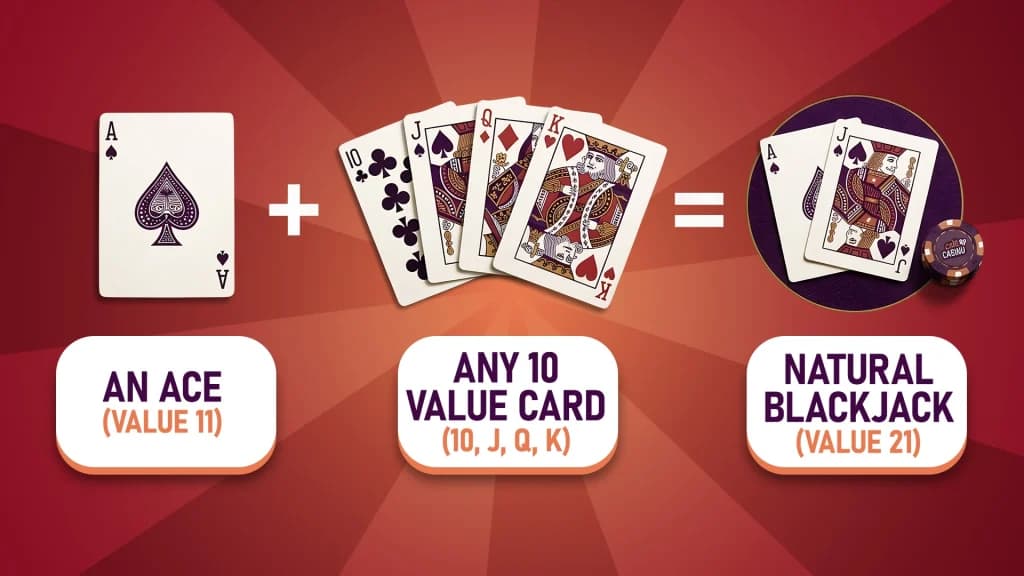
If you receive an ace followed by a Queen or any other ten-value card, that’s a natural blackjack, and from there, you cook. If you complete 21 after splitting, however, it doesn’t count as blackjack.
Most tables pay 3-to-2 for a blackjack, but some are 6-to-5 blackjack tables. On a $10 bet, that’s a $15 payout vs. $12, respectively, so always choose 3:2 when given the option.
Ace and 8: Soft 19
A soft 19 in blackjack is an ace and an 8, and it’s a solid total, so you should almost always stand. If you’re playing under H17 rules, double against a dealer’s 6.
Ace and 9: Soft 20
Any time you have 20, just stand. Don’t even think about doing anything else. The total is too good to pass up.
Two Aces
Two Aces count as either 2 or 12, and you should always split them. More on that in the next section.
How to Play Your Ace Hands
A basic strategy chart gives you a game plan for playing your ace hands. It’s not a guaranteed way to win (would be nice, tho), but the chart tells you the best mathematical decision, which increases your returns over time. That’s also true when you play classic blackjack online, not only in a land casino.
Doubling Down on Soft Hands
Doubling down means you add another equal bet to your first wager and receive one more card. Doubling is a prominent move on soft 13 through soft 18 against many weak dealer upcards (2 through 6).
Why? Because you can’t bust by drawing one more card. On the flip side, the dealer must hit on everything 16 and lower. The more they hit, the more likely they are to bust. Your best move is to put the pressure on and watch them sweat.
Splitting Aces
Two aces mean one thing: split. Now you’ve got two aces up your sleeve. Slick. Splitting aces in blackjack is the right move because with two aces and a higher concentration of 10-value cards in the shoe, you have two chances to reach 21.
However, most tables are party poopers and will only let you take one more card per split ace. At all tables, a 10-value card after a split ace only counts as 21 and pays 1:1, not as a blackjack paying 3:2.
What Happens When the Dealer Has an Ace
In blackjack, what is an ace for the dealer?
When the dealer shows an ace, it’s counted as 1 or 11, just like yours. The difference is that they must play according to the house rules and cannot make their own decisions.
In standard blackjack, the dealer must hit any total below 17. The rules get spicy if the dealer shows a soft 17, which brings us to H17 vs. S17 tables.
S17 stands for Stand on Soft 17. It means the dealer cannot take another card on any soft 17, like if they’re dealt an Ace + 6. This is better for the player because the dealer doesn’t have another chance to improve.
H17 is the opposite, meaning the dealer must hit on Soft 17. This rule slightly increases the house edge because it gives the dealer more chances to improve their hand.
A dealer’s ace also opens up another move for you, the player. But before you get excited, you should know that it’s not a good move.
Insurance
When the dealer’s upcard is an ace, the dealer or online game will present you with the option to take insurance. If you take it, you pay half of your original bet and win 2:1 if the dealer has blackjack. If not, you lose your original bet and your insurance bet.
While it may seem like a safety net, it’s not. So what is blackjack insurance? It’s a side bet that the dealer has blackjack, which only happens about 30.8% of the time. That is also known as: not worth the risk.
If you already have blackjack and the dealer shows an ace, you might be offered “even money” instead. This means you accept a guaranteed 1:1 payout. At a 3:2 table, that’s the same result as taking insurance, which means…yep, you got it. Say no to even money, too.
Putting Your Ace to Work
Let’s review.
An ace is worth 1 or 11, depending on which helps your hand most. Soft hands are flexible and require a different move than hard hands. Always split aces, and ignore the game’s offer of insurance or even money. A sincere “Nice try, sweet pea,” would work nicely.
If you want to take your soft skills to the wild, play blackjack games online at Cafe Casino. After finishing our guide, we know one thing for sure: this player has an ace up their sleeve.
FAQs
Can an ace be worth 10 in blackjack?
No. An ace can only be worth 1 or 11 depending on convenience. Only the 10 card and face cards (J, Q, K) are worth ten.
Is an ace and a 10 always a blackjack?
An ace and a 10 only count as blackjack if you get it within the first two cards. If you split two aces and receive another 10-value card, that’s a regular 21 and not a blackjack.
Can the value of my ace change after I hit?
Yes, your ace’s value will adjust automatically to protect you from busting as you receive more cards; you don’t have to do anything special to assign its value.
Is an ace a good first card in blackjack?
Yes, an ace is the strongest card you can start with in blackjack. That said, receiving an ace doesn’t guarantee a high total or a win.
Should I take insurance when the dealer shows an ace?
No. Insurance is a side bet that the dealer will have blackjack, and that only happens 30.8% of the time.
Can you split aces more than once?
Whether you can split aces more than once depends on the specific table’s rules. Open the info panel or pay table, and look for “resplitting after Aces.”
What does A/7 mean on a blackjack table?
A/7 refers to an Ace + 7, otherwise known as a soft 18 (because the Ace is 11, plus the regular 7). You might see this A/7 shorthand on strategy charts. The same cards can also add up to 8 when you count the ace as 1.
More Blackjack Tips & Tricks
November 5, 2026
What Is DAS in Blackjack? Double After Split, Explained
What Is DAS in Blackjack? Double After Split, Explained What is DAS in blackjack? DAS stands for “Double After Split.” You’ll encounter this rule on an online blackjack paytable or rules placard if you’re playing in person. You’ll also see it factored into strategy charts, which is a key focus of this DAS guide. We’ll […]

November 3, 2026
Blackjack Guide: How to Play, What to Bet, and When to Make Your Move
Learn how to play blackjack, including the card values, the five key moves you can make, and a handful of special hands. It’s easy once you get the hang of it.

September 21, 2026
Blackjack Terms: A Guide to the Language of the Table
This blackjack glossary covers all of the terms you’ll hear when playing blackjack, from moves to rules to slang. Learn the terms now, grouped by situation.

March 23, 2026
Splitting 6s in Blackjack: A Decision at the Crossroads
At the crossroads of two 6s, what do you do? Your move depends on the dealer’s upcard and the rules. Don’t worry—we’ll explain everything. Learn the moves now.