
How to Play Video Poker: Poker at Your Own Pace
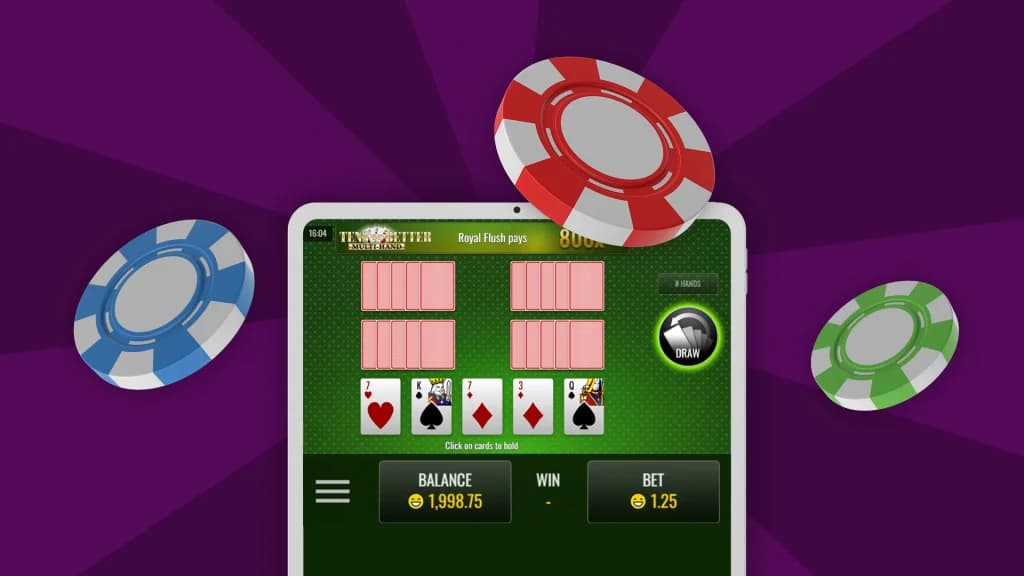
Video poker is poker with everything stressful taken out of it. No opponents reading your face, no bluffing, nobody sighing while you decide. Just you, five cards, and a decision entirely yours to make in your own time. It takes about five minutes to learn, and you will know how to play by the end of this page.
Two things separate it from a slot game. You choose which cards to keep, so the outcome responds to what you decide. And every payout is printed on screen before you bet, so you know what each hand returns before any money moves.
Below: one complete hand start to finish, the winning hands and what they pay, how to read a pay table, which cards to hold when the call is close, and how to pick a first game.
What Is Video Poker?
Video poker is a solo five-card draw hand played against a machine rather than against other players.
The shape of a hand is short. Five cards from a standard deck. You choose which to keep and which to throw away, and the discards are replaced in a single draw. Whatever you hold at that point is scored against a published pay table and paid automatically.
The cards come from a random number generator, a piece of software producing an unpredictable result for every deal. Each hand comes from a freshly shuffled virtual deck with no memory of what came before it, so a cold run does not make a good hand any more likely on the next deal.
With no dealer waiting and no table watching, nothing is pushing you to decide. You can sit on a hand for a minute or ten. Nothing happens until you press the button.
If you have come from slots, the pace will feel familiar and the control will not. Same solo rhythm, same sit-down-and-play accessibility, but your choices move the result rather than just triggering the next spin. The comparison is worth reading in full in video poker vs slots.
How to Play Video Poker: Step by Step
Here is one complete hand, from the first bet to the credits landing in your balance.
- Choose your coin denomination. This sets what a single credit is worth. It is the base unit everything else is built from, so start low while you are learning the game.
- Choose how many coins to bet. Most games allow one to five coins per hand. Payouts scale with the coin count, and the top hand usually scales further at five coins, which is why experienced players bet maximum. Bet within your budget rather than stretching to reach it.
- Press Deal. Five cards appear face up. This is your starting hand and the only cards you will see before your decision.
- Choose your holds. Press Hold under each card you want to keep. Held cards are marked on screen, and you can press again to unhold. Nothing locks in until the next step.
- Press Draw. Every card you did not hold is replaced in one go. There is no second draw. The five cards on screen after this are your final hand.
- Get paid. The machine scores your hand against the pay table and pays automatically. There is no decision left to make and nothing to claim.
Your credits then update on screen. You can change your bet size or denomination, or press Deal and start the next hand. There is no clock on the hold decision either. Take as long as you want; the hand sits there until you act on it, which is one of the real pleasures of the game.
Video Poker Hand Rankings and What They Pay
Every decision in video poker comes back to one question: which hand are you building toward? So it is worth knowing the ladder before you play.
From strongest to weakest, in a standard Jacks or Better game:
- Royal flush. Ten through ace, all one suit: 10♠ J♠ Q♠ K♠ A♠. The top hand in the game.
- Straight flush. Five cards in sequence, all one suit, such as 5♥ 6♥ 7♥ 8♥ 9♥.
- Four of a kind. All four of one rank, such as 7♠ 7♥ 7♦ 7♣.
- Full house. Three of one rank and two of another: K♠ K♥ K♦ 4♠ 4♣.
- Flush. Five cards of one suit, not in sequence: 2♦ 6♦ 9♦ J♦ K♦.
- Straight. Five in sequence, mixed suits: 4♠ 5♥ 6♦ 7♠ 8♣.
- Three of a kind. Three of one rank, such as 9♠ 9♥ 9♦.
- Two pair. Two separate pairs: J♠ J♥ 5♦ 5♣.
- Jacks or better. A single pair of jacks, queens, kings or aces. Anything lower does not pay in this variant.
That last entry is what is meant by a minimum qualifying hand: the weakest hand the game will pay anything for. It changes between variants and it is the first thing to check when you try a new one. In Jacks or Better it is a pair of jacks. In Deuces Wild it rises all the way to three of a kind, because the four wild cards make weaker hands far too easy to reach.
The ranking order never changes. A flush always beats a straight, in every variant. What changes between games is how much each hand pays, which is a different thing entirely and the subject of the next section. Where a game includes wild cards, hands higher up the ladder come within reach more often, and the variant compensates by paying less at the bottom. It is a trade, not a gift.
How to Read a Video Poker Pay Table
The pay table is on screen before you bet a penny. It tells you exactly what every hand returns, which means video poker asks you to make a decision with the odds already printed in front of you. Very few casino games do that.
Reading it takes about thirty seconds. Winning hands run down the left, strongest at the top. Coins wagered run across the top, usually one through five. Find your hand, follow the row across to your bet column, and that is your payout in credits.
Full pay describes a machine running the most generous version of a pay table. Two machines can share a name and pay different amounts for the identical hand, which is why the title tells you less than the numbers underneath. In Jacks or Better, paying 9 for a full house and 6 for a flush is full pay, returning around 99.5% with correct play. A version paying 8 and 5 returns noticeably less.
The royal flush also jumps disproportionately in the five-coin column, often from 250 per coin to 800. That single step is why experienced players bet maximum coins, because a meaningful slice of the game’s return lives there. If five coins stretches your budget, drop to a smaller denomination and bet five of those instead.
One check to run on any video poker game before you play it: look at the full house and flush rows in the one-coin column. Those two numbers tell you more about what the game returns than anything else on the screen.
Which Cards Should You Hold?
Holding is the only real decision in video poker, and the whole difference between playing the game and guessing at it. Most hands have an obvious answer, and the ones that do not come down to a short list of rules.
Never break these up. If you have been dealt one, hold all five cards and draw nothing:
- A royal flush, a straight flush, four of a kind, a full house, a flush, or a straight.
The close calls come up far more often. Here is what to do with each:
- A low pair against a single high card. Hold the pair. A pair of fours beats a lone king, because the pair can improve to trips, a full house or quads, while a high card has to find a partner first.
- Four to a flush against a low pair. Hold the flush draw. One card completes it, and a flush pays more than the two pair or trips the low pair is likely to reach.
- Four to a flush against a high pair. Hold the high pair. It already pays, and the flush draw does not come in often enough to justify giving up a made hand.
- An open-ended straight draw against an inside one. Take the open-ended draw. It has twice as many outs as a four-card run with a gap in the middle. An inside draw with no high cards is usually not worth holding at all.
There is one situation where breaking up a made hand is correct: when you are holding four cards to a royal flush. Break a made flush or a made straight to draw for it. The royal pays so much more than either that the trade is worth making, and this is the one place where giving up a guaranteed payout is the right play.
A common instinct worth resisting: holding an extra high card alongside a pair. If you have a pair of queens and an ace, hold the queens and throw the ace. Keeping the ace means drawing two cards instead of three, and it removes a draw without adding anything, because the ace cannot improve the pair you already have.
Video Poker Odds and Basic Strategy
Here is the part that makes video poker different from almost every other machine game on a casino floor: your decisions really do move the result. Two players at identical machines making different hold choices will get different returns over time, and the gap between playing well and guessing is not small.
Return to player is the share of all money wagered a game pays back over a very long run. In video poker it depends on the variant and on which pay table that machine is running. Full-pay Jacks or Better with correct play returns around 99.5%, among the strongest figures on any casino floor. The same game on a weaker pay table returns less, and no amount of good play recovers the difference.
Three habits keep a beginner close to correct play. Stick to one variant until it feels automatic. Learn that variant’s holding rules properly, since Jacks or Better rules do not transfer cleanly to Deuces Wild. And check the pay table every time you sit down at a new game.
You can practise all of this for free. Most video poker games offer a practice mode dealing real hands with no money at stake, which is the right place to work through the holding decisions.
Worth saying plainly: no strategy guarantees a win, and results over a single session will swing in both directions regardless of how well you play. Only play with money you are comfortable losing, set a budget before you start and use deposit limits to hold yourself to it. If gambling stops feeling like entertainment, the National Problem Gambling Helpline is free and confidential on 1-800-522-4700, or at ncpgambling.org.
Choosing Your First Video Poker Variant
Picking the right first game matters more than memorising every rule in this guide. Start on the wrong variant and you will spend your first session fighting holding rules never designed for a beginner. Three games are worth knowing about.
| Jacks or Better | Deuces Wild | Bonus Poker | |
| Minimum winning hand | A pair of jacks or better | Three of a kind | A pair of jacks or better |
| Wild cards | None | All four twos are wild | None |
| What makes it different | The baseline game the others are built from. Clean pay table, no surprises | Four wilds put strong hands within reach far more often, so the qualifying hand rises and low hands pay nothing | Same structure as Jacks or Better, but four of a kind pays more depending on rank, funded by lower full house and flush payouts |
| Learning curve | Shortest. The holding rules are the ones most guides teach | Steepest. Wild cards change almost every holding decision | Short if you already know Jacks or Better, since the strategy is close but not identical |
| Best for | A first game, and the one to learn properly before trying anything else | Players comfortable with Jacks or Better who want more swing in a session | Players who enjoy chasing four of a kind and accept smaller wins elsewhere |
Start with Jacks or Better. It is the cleanest version of the game, the strategy is the most widely documented, and everything you learn on it carries over in some form to every other variant. Once the holding decisions stop requiring thought, Bonus Poker is the natural next step because the structure is familiar. Leave Deuces Wild until after that, since the wild cards rewrite the strategy rather than adjusting it. There is a broader tour of the family in the wide world of video poker, and you can start on Jacks or Better video poker whenever you are ready.
One more format worth a mention. Multi-hand video poker takes your single set of hold decisions and plays them across several hands at once, each drawing from its own deck. The decisions are identical, but you stake each hand separately, so the total bet multiplies. Same skill, larger size.
Disclaimer from the Cafe Casino team: No matter your strategy, roulette is a game of pure luck, so never expect a guaranteed win. Focus on playing for fun, not necessarily for profit. Know your limits, and whether things are going your way or not, there’s no shame in walking away. The real win is playing smart and having a good time. The strategies outlined in this article are the beliefs of the author and have no guarantee in securing a win.